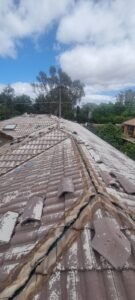
Most roof repairs in Melbourne do not need a building permit. A full re-roof, a change of roofing material, or anything that touches the structure underneath usually does.
That distinction matters, because getting it wrong is a criminal offence under the Building Act 1993, and the penalties are steep. Here is how the rules actually work in Victoria, what changed in 2026, and how to tell which side of the line your job sits on.
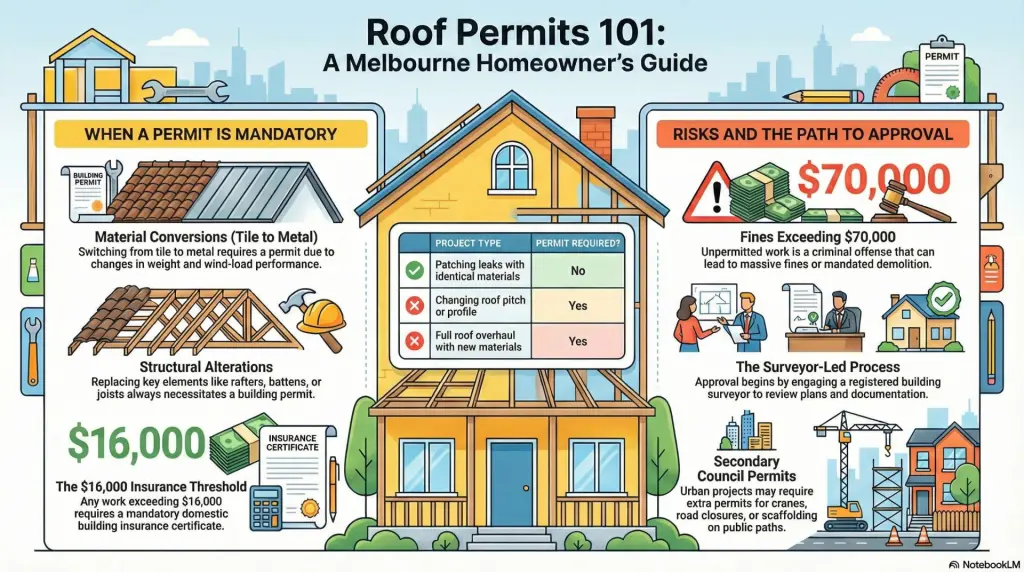
Building permit or planning permit? They are not the same thing
These two get confused constantly, so it is worth separating them.
A building permit is about the construction work itself. It confirms the job meets the safety and structural standards set out in the Building Regulations 2018 and the National Construction Code. It is issued by a registered building surveyor, either private or through your council.
A planning permit is about land use and what your property is allowed to look like. It comes from your local council. For most roof repairs it is irrelevant, with one big exception covered further down: heritage overlays.
If your job needs both, the planning permit comes first.
Roof work that usually does not need a building permit
Routine maintenance that does not alter the structure or the roof form is generally exempt under Schedule 3 of the Building Regulations 2018. In practice, that covers most of what we do day to day:
- Fixing a leak
- Replacing cracked, slipped or broken tiles with matching tiles
- Re-bedding and re-pointing ridge capping
- Replacing rusted valley irons and flashings on a like for like basis
- Cleaning, sealing and coating an existing roof
- Clearing and repairing gutters and downpipes
The common thread is that the roof ends up the same shape, the same material and carrying the same load as before. Nothing structural changes.
Roof work that does need a building permit
You are changing the roofing material
Swapping concrete or terracotta tiles for Colorbond sheeting is the classic example. Tiles and metal behave very differently in terms of weight and wind uplift. A tiled roof might carry 45 to 55 kilograms per square metre, while metal sheeting sits closer to 5. The existing frame was designed for one and not the other, so the change needs assessing, often by a structural engineer.
The work touches the structure
Replacing or altering battens, rafters, trusses or joists is structural work and triggers a permit. Repairing a couple of rotted battens while replacing tiles is usually treated as maintenance. Re-battening an entire roof is not.
You are changing the roof form
Altering the pitch, changing the profile, extending the roofline or cutting in new openings such as skylights or roof windows all require a permit.
Your property is in a heritage overlay
This one catches people out. In parts of Footscray, Williamstown, Newport, Moonee Ponds and Ascot Vale, a heritage overlay can mean that even visible like for like repairs need a planning permit first. Councils care about what the street sees. Check your property on the VicPlan mapping tool or ring your council before committing to anything.
What changed on 1 July 2026
Two things worth knowing, because most guides online are still repeating the old rules.
The insurance threshold moved. Domestic Building Insurance used to be required on residential work over $16,000. From 1 July 2026 the Home Warranty scheme replaced it, and the threshold rose to $20,000. Contracts signed before that date stay under the old DBI policy on the old terms.
The regulator changed. The Building and Plumbing Commission took over from the Victorian Building Authority in July 2025. It now handles registration, insurance and enforcement for builders and plumbers.
A typical repair sits well under the insurance threshold. A full re-roof on a family home very often clears it, so ask your roofer to show you the certificate before any money changes hands.
The permits people forget about
A building permit is not the only approval a roof job can need, particularly on tight blocks and multi storey homes.
- Council permits for public space. Scaffolding on the footpath, a skip on the nature strip, or a crane or cherry picker taking up the road all need council approval. Lead times vary by council, so this gets organised early.
- No-go zone permits. Working near overhead powerlines requires clearance from the distributor, which across Melbourne’s west is usually Powercor. Depending on the distance, that can mean insulated tiger tails fitted to the lines before anyone goes up.
- Asbestos removal. Older roofs, eaves and sarking can contain asbestos. Removing more than ten square metres of non-friable asbestos requires a licensed removalist and proper disposal.
What happens if you skip the permit
Carrying out building work without a required permit breaches section 16 of the Building Act 1993. The maximum penalty is 500 penalty units for an individual and 2,500 for a company. Penalty unit values are indexed every July, which currently puts the maximum fine for a homeowner north of $90,000.
Fines are only part of it. Council can issue a building notice or order requiring you to open the work up for inspection, rectify it, or remove it entirely at your cost. Your insurer may decline a claim connected to unpermitted work. And when you sell, unapproved building work has to be disclosed, which is exactly the sort of thing that stalls a settlement.
How the permit process works
- Engage a registered building surveyor. They assess the work and issue the permit. Your roofer will usually have one they work with.
- Put the documentation together. Plans, specifications, product details and engineering computations if the structure is involved.
- Lodge the application and pay the fees.
- Assessment. The surveyor checks the proposal against the Act, the Regulations and the NCC, and may come back with requests for further information.
- Permit issued. Work can start, with mandatory inspections at set stages and a final certificate once it passes.
Straightforward roofing permits generally move faster than the headline figures you see quoted for building approvals overall, because the scope is narrow and well understood. Heritage overlays and engineering sign off are the two things that add time.
A recent job in Wyndham
We replaced a tiled roof with Colorbond on a two storey home in Wyndham. Because the material changed, it needed a building permit and an engineering assessment of the existing frame.
Powerlines ran about six and a half metres from the roof edge, so a no-go zone permit was required and tiger tails were fitted before work started. The block backed onto a narrow laneway, which meant a road occupation permit for the lift. Two air conditioning units had to be lifted off and reinstated to get the new sheets laid properly.
None of that is unusual for a job of that size. It just needs sorting before the first tile comes off, not halfway through.
Quick check: does your job need a permit?
Ask yourself three questions. Is the roof changing material? Is anything structural being replaced? Is the shape, pitch or profile changing?
If the answer to all three is no, and you are not in a heritage overlay, you are almost certainly looking at exempt maintenance. If the answer to any is yes, budget for a permit.
When it is genuinely borderline, a registered building surveyor will give you a straight answer, and that conversation costs a lot less than an enforcement order.
Frequently asked questions
Do I need a permit to replace broken roof tiles?
No. Like for like tile replacement is maintenance and does not require a building permit, unless a heritage overlay applies to your property.
Do I need a permit to replace my whole roof?
Usually yes. A full re-roof is treated as an alteration to the building. If the material changes or the structure is touched, a permit is required.
Does a roof restoration need a permit?
Generally no. Cleaning, repairing, re-bedding, re-pointing and coating an existing roof leaves the structure and material unchanged, so it falls within the maintenance exemptions.
Who is responsible for getting the permit?
Where you engage a registered building practitioner, the obligation sits with them under section 16 of the Act. Owner builders carry it themselves.
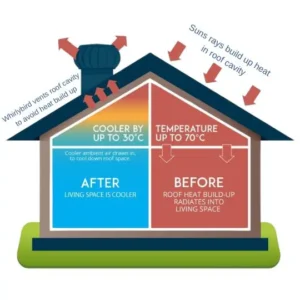
Do I need a permit for a whirlybird or roof vent?
Standard whirlybird installation does not require a building permit. Cutting in a large opening or altering framing to suit is a different matter.
Talk to a licensed local roofer
Silverline Roofing works across Melbourne’s western suburbs on tiled and metal roofs. We will tell you honestly whether your job needs a permit, and if it does, we handle the surveyor, the paperwork and the council approvals so you are not chasing it.
Explore our roof repairs, roof restorations, emergency roof repairs and whirlybird installation services, or call 0403 131 908 for a free, no obligation quote.