Walk into an upstairs bedroom in Melbourne in February and you will feel it straight away. The room is several degrees hotter than the rest of the house, and it stays that way well into the evening.
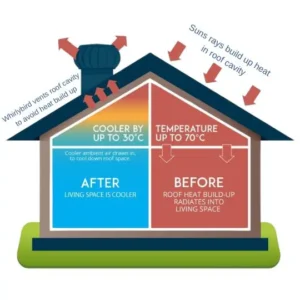
That heat is coming from your roof space. On a 35 degree day a poorly ventilated roof cavity can sit at 60 degrees or higher, and that heat radiates down through the ceiling for hours after the sun has gone. Roof ventilation is the cheapest fix available, and most Melbourne homes are short of it.
How a whirlybird actually works
A whirlybird is a wind driven turbine vent. As air moves across the roof it spins the turbine, which draws hot air up and out of the roof cavity. Cooler air is pulled in through the eaves to replace it, so you get continuous airflow with no power, no wiring and nothing to maintain.
The physics helps too. Hot air rises on its own, so the turbine is assisting a process already happening rather than fighting it. Even on a still day you get some convection movement.
Why it matters in summer
Trapped heat in the roof cavity radiates through your ceiling insulation and into the rooms below. Venting that heat lowers the cavity temperature, which takes load off your air conditioner and makes upstairs rooms usable in the afternoon.
It will not replace air conditioning. Anyone who tells you it will is overselling. What it does is stop your cooling fighting a 60 degree roof cavity, which means shorter run times and lower bills.
Why it matters in winter, which surprises people
Ventilation gets dismissed as a summer thing. In Melbourne, the winter benefit is arguably the bigger one.
Warm moist air rises out of your living areas, from showers, cooking, drying clothes indoors and simply breathing. When it hits the cold underside of a roof it condenses. That moisture sits in the roof cavity, dampens insulation and eventually causes mould on the timbers and rot in the battens.
Damp insulation is also poor insulation. It loses much of its thermal value, so you are heating a house that leaks warmth. Venting the cavity keeps the air moving and the timbers dry.
How many do you need?
The rough guide is one whirlybird per 90 square metres of roof space. Most single storey homes in Melbourne’s west end up with two to four.
Numbers alone are not the whole story. Placement matters more than people think. Whirlybirds go high on the roof, near the ridge, where the hottest air collects. Spread across the roof rather than clustered together, and positioned to work with prevailing winds.
Just as important is intake. Extraction without intake achieves very little, because the air has to come from somewhere. Eave vents or soffit vents let cool air in low so the whirlybird can pull hot air out high. If your eaves are sealed or packed with insulation, that gets sorted first.
Different roofs, different installs
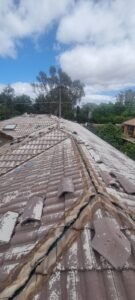
Tiled roofs. Tiles are lifted, the opening is cut, and the base flashing is dressed into the surrounding tiles so water sheds over it. Done properly you cannot see where the work happened.
Metal and corrugated roofs. The base is cut to match the profile of the sheeting and sealed against the ribs. Metal expands and contracts noticeably in Melbourne’s temperature swings, so the flashing has to allow for movement rather than fight it.
Either way, the failure point is always the flashing, not the turbine. A whirlybird that leaks was installed badly. It is not an inherent flaw in the product.
What about heritage overlays?
In parts of Footscray, Williamstown, Newport and Moonee Ponds, heritage overlays can restrict what is visible from the street. That rarely rules out ventilation altogether. It usually just changes placement, moving units to a rear facing roof plane. Worth a call to your council before booking anything.
Are they noisy?
A quality whirlybird, properly installed, is close to silent. The noise complaints you read about almost always trace back to cheap units with poor bearings, or a unit installed slightly out of level so the turbine wobbles. Both are avoidable.
Good time to do it
If you are already having a roof restoration done, add the ventilation to the same job. The roofer is already up there with the safety setup in place, and tiles are coming off anyway. Doing it as a standalone visit later costs more.
The same logic applies to gutter cleaning and general maintenance. Bundle the roof work.
Frequently asked questions
Do whirlybirds really work?
Yes, when there are enough of them, they are placed correctly, and there is adequate intake ventilation at the eaves. A single unit on a large roof with sealed eaves will not do much.
Do they use electricity?
No. They are wind driven, so there is nothing to wire in and no running cost.
Will a whirlybird leak?
Not if the flashing is done properly. Leaks come from poor installation, not from the unit itself.
How long do they last?
A good quality unit will run for fifteen to twenty years. Bearings are the part that eventually wears.
Do I need a permit to install one?
Standard whirlybird installation does not require a building permit. Cutting a large opening or altering roof framing is a different matter.
Can they be installed in winter?
Yes. Installation is not weather dependent the way roof coating is, so it can be done year round.
Sort your roof ventilation before summer
Silverline Roofing supplies and fits whirlybirds across Melbourne’s western suburbs on both tiled and metal roofs. We will assess your roof space, tell you how many units you actually need and where they should go, and flash them properly so they never leak.
See our whirlybird installation service, or call 0403 131 908 for a free assessment. If you have noticed damp or mould in the roof space, book a roof inspection at the same time.